Chapter 1
IN THIS LESSON
Ceramic Processing: Slip Casting
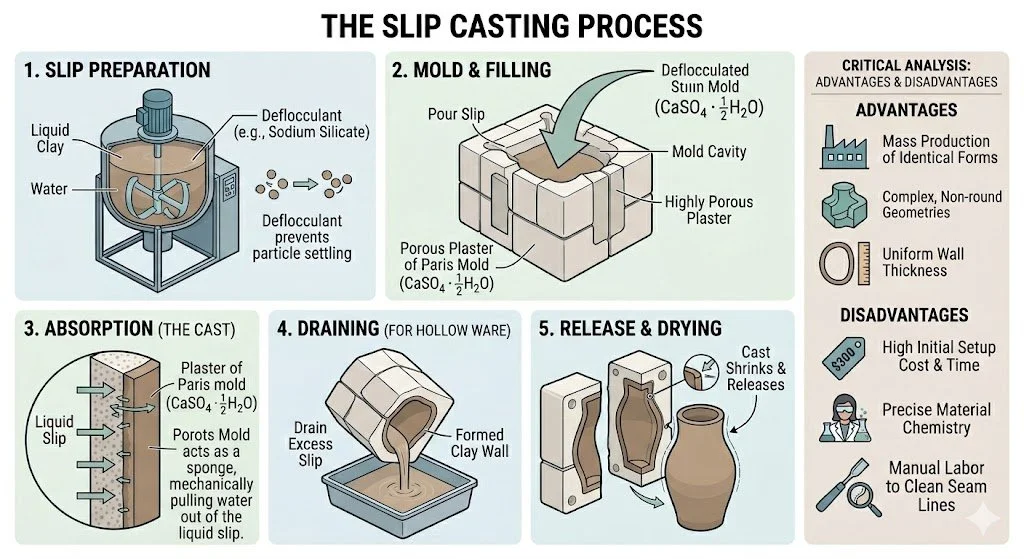
To effectively teach the fundamentals of slip casting, students must first understand the chemical and mechanical relationships between the materials involved. The process begins with slip—a liquid clay body mixed with a deflocculant like sodium silicate to keep clay particles suspended in less water, which ultimately minimizes shrinkage. This slip is poured into a highly porous plaster of Paris (CaSO4⋅21H2O) mold, which acts like a sponge to mechanically pull water out of the liquid mix. As water is absorbed, a solid layer of clay builds up against the inner walls of the mold; once the desired wall thickness is achieved, the remaining liquid slip is drained out. As the cast dries, it shrinks slightly and releases from the walls for removal. Introducing this method allows students to critically evaluate its unique advantages and disadvantages in production. While slip casting is highly efficient for mass-producing identical forms and achieving complex, non-round geometries with uniform wall thickness, it requires a high initial setup cost, precise material chemistry, and manual labor to clean up the seam lines left behind by the molds.
-
Add a short summary or a list of helpful resources here.